Often, sustainability in construction is focused on carbon emissions and environmentally friendly buildings. However, it is much broader than that. On World Sustainability Day 2026, and with COP31 fast approaching, this blog delves into the role of logistics in waste reduction in the construction industry.
The construction sector is one of the UK’s largest consumers of raw materials and producers of waste. As the industry moves towards a more sustainable future, embracing the principles of the circular economy offers a significant opportunity to reduce environmental impacts, improve resource efficiency, and create long-term value.
This is also topical as the 31st Conference of the Parties (COP) will take place from 9 to 20 November. It is at COP that world leaders come together to discuss key sustainability topics and progress towards meeting net zero. This year, one of the Action Agendas is reducing waste through scalable circular economy solutions, so now is a more appropriate time than ever to understand how these circular economy principles can be implemented to reduce waste in our industry.
WHAT IS A CIRCULAR ECONOMY?
Traditional construction has largely followed a linear model:
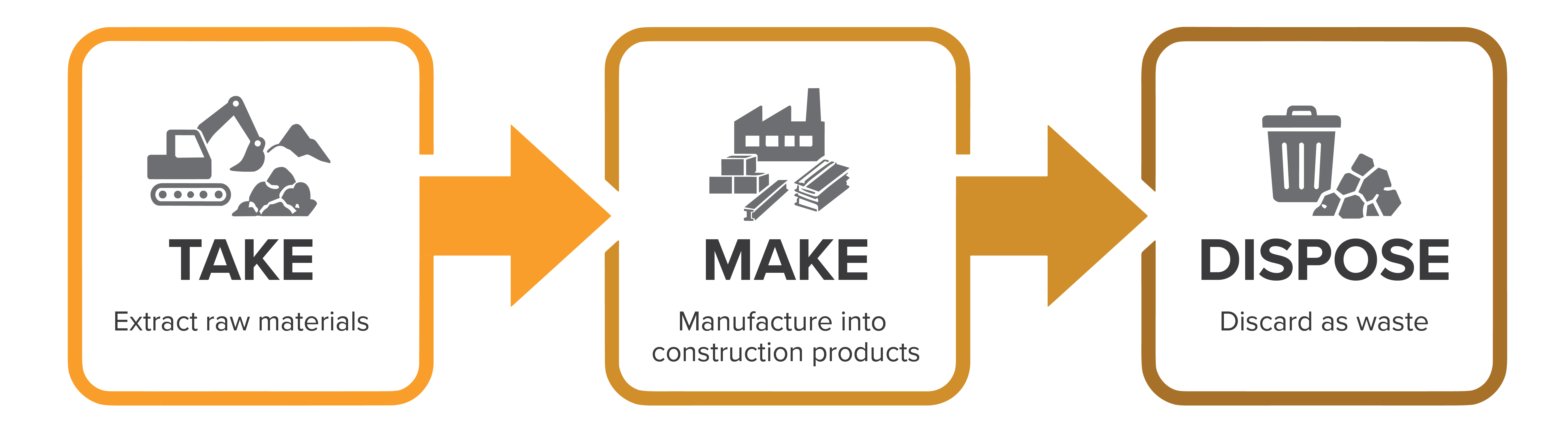
In this model, raw materials are extracted from the environment, then processed into construction materials and assembled at the construction site in ways that cannot be deconstructed, becoming obsolete at the end of the building’s life and having to be disposed of in landfill or incinerated.
A circular economy takes a different approach. It aims to keep materials and products in use for as long as possible by reducing waste, reusing materials, repairing products, and recycling resources at the end of their life. Rather than viewing waste as an unavoidable by-product, a circular economy sees it as a valuable resource that can be retained within the system (Ellen MacArthur Foundation).
WHY DOES THIS MATTER FOR CONSTRUCTION?
Construction, demolition and excavation activities account for around 60% of material use and waste generation in the UK, making the sector one of the country’s largest waste producers.
Data from the UK Government shows that England generated approximately 63 million tonnes of non-hazardous construction and demolition waste in 2022. Although over 93% was recovered, millions of tonnes of material still require disposal or are downcycled into lower-value applications.
These figures demonstrate both the challenge and the opportunity for the construction industry. If waste can be reduced before it is generated, the benefits extend far beyond landfill diversion. Reducing waste lowers demand for virgin materials, reduces transport emissions, improves project efficiency, and can lead to significant cost savings.
LOGISTICS PLANNING FOR WASTE PREVENTION
Before construction works begin on site, logistics management can prevent waste by avoiding materials being over-ordered or arriving before they can be stored safely, preventing duplicated deliveries, and reducing excess packaging and damage to products during transport.
The SmartWaste UK Construction KPI Benchmark Report, published by the Building Research Establishment (BRE), examined the UK construction sector’s waste management performance using 10 years of data. The findings showed that while the construction sector has become more economically efficient, with project waste per £100,000 decreasing by 28%, it has become over 10% more materially wasteful. The difference indicates that although projects are producing less waste relative to cost, they are becoming more material‑intensive and wasteful when measured against the final built assets.
It is estimated that 10–30% of the construction materials that end up as on-site waste are never actually used. Poor logistics management – including inaccurate material forecasting, inefficient delivery scheduling, and inadequate on-site storage arrangements – leads to damaged, lost or unusable materials. By contrast, robust logistics planning ensures that the right materials are delivered in the right quantities, at the right time, and to the right location, reducing unnecessary transportation, minimising material handling, and preventing waste arising from over-ordering, damage and deterioration.
As this shows, effective logistics planning from the outset has a vital role to play in supporting circular economy principles in the construction sector. By reducing waste at the source and maximising material efficiency, it reduces consumption of virgin resources, keeps materials in use for longer, and improves opportunities for reuse and recovery.
SEEING WASTE AS A RESOURCE
Government data shows that more than 90% of non-hazardous construction and demolition waste in the UK is recovered for some form of recycling. Waste diversion from landfill reached 99.5% in 2025 – clear evidence of success in prioritising this aspect of waste management in our sector.
However, recovery and recycling are just part of the solution. There is a growing need to shift the focus towards improving other performance metrics, in particular maximising opportunities for reuse before recycling becomes necessary. To meet the circular economy principles, materials that were once sent directly to landfill may now be reused on future projects, returned through supplier take-back schemes, refurbished for a second life, recycled into new construction products, or repurposed for alternative uses.
For example, pallet take-back schemes such as Scott Pallets and Pallet Loop aim to ‘close the loop’ on pallet waste. With over 20 million pallets used to move building materials in the UK alone, take-back schemes such as these are an important way to minimise unnecessary virgin material use and embrace circular economy principles by reusing pallets.
In another great example of reuse shown below, cable reels have been turned into furniture for the community centre in Tadley, Hampshire. Refurbishing the cable reels prevented them from going to landfill and has enhanced the community.


LOOKING TO THE FUTURE
As sustainability expectations continue to grow, leveraging opportunities to implement circular economy principles within the construction sector is becoming increasingly important. Clearly, reducing waste is high on the sustainability agenda, as highlighted by its inclusion in the Action Agenda at COP31. The United Nations’ Sustainable Development Goals also provide a compelling call to action in key areas, including:



By embracing circular economy principles, we have an opportunity to reduce waste, improve efficiency, and create greater value from the materials we use. Construction logistics plays a key role in this transition by helping projects minimise waste, optimise resource use, and reduce environmental impacts before materials even reach site.
As the industry continues its journey towards a more sustainable future, moving from a linear ‘take, make, dispose’ model to a circular approach will be essential. Better planning, collaboration, and logistics management can help ensure that today’s resources continue delivering value long into the future.
Megan Colbeck is Bridgehead’s Environmental Advisor. If you would like to find out more about how we build sustainability into every aspect of our work, please get in touch.
Sources